3/21/08

blf on worldchanging

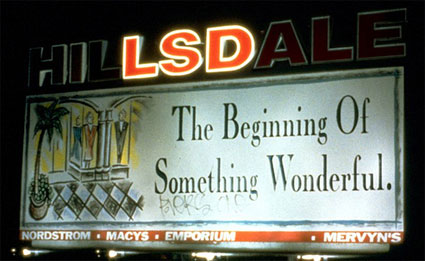
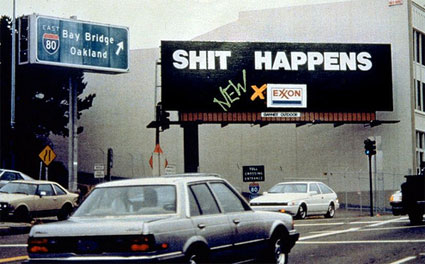
a few days after i posted on the billboard liberation front, regine, of we-make-money-not-art wrote a great piece which discusses blf's history and practices.


i found this bit of advise on billboard improvement worth reposting here (but you really should read the article):

- Minimize property damage and respect the sign men. BLF make modification which are easy to remove and always leave some beer or liquor for the men who have to come and clean their "improvements."


(found via worldchanging)


3/12/08

Billboard Liberation Front


I had a very similar idea for this at&t campaign a few months ago. I glad the billboard liberation front had a better one and the resources to execute.

(via the anti-advertising agency)


3/7/08

"reaganomics in greenface"

great post via earth2tech

“Green-collar jobs” has entered the zeitgeist with the help of political promises and media infatuation. Most recently the EPA has put $2.5 million into the Brownfields environmental job training program, one of the government’s oldest efforts to train a greener workforce.

The most outspoken, and well-spoken, advocate for green-collar jobs has been environmental justice crusader Van Jones. Co-founder of the Ella Baker Center for Human Rights in Oakland, Jones was the subject of a recent Q&A with the Sun Magazine in which he sounds off on “eco-elites,” green Reaganomics, and explains why cleantech entrepreneurs are leaving the working class behind.

Jones is concerned that the cleantech movement is growing away from the working class. “Nobody is showing people of modest means how they will benefit from green energy,” he said. “Green is the new gold for rich eco-entrepreneurs, but it can be just one more burden for low-income people if they get stuck paying higher rates.”

Coal, oil and gas companies have long threatened higher power rates to stall emissions regulations. But Jones points out that cheap, dirty power comes at a high environmental and medical price. And all too often it is low-income communities who bear the brunt of a fossil fuel economy’s pollution. Asthma rates in Oakland are among the highest in the state. Jones doesn’t want to see the same environmental injustices perpetuated in the emerging clean economy.

It would be easy to say that once we have renewable this and organic that, everybody will benefit, but that’s not a progressive policy; it’s just trickle-down Reaganomics in “greenface.” Of course there will be jobs created, but will kids over in west Oakland be able to get those jobs? Will we be satisfied with a sustainable economy that, at the end of the day, is eco-apartheid?


Jones has likened the movement he envisions to Roosevelt’s New Deal and Johnson’s Great Society. He foresees a green economy that will not only make Silicon Valley executives rich but employ a green proletariat that undertakes the process of retrofitting a great society into a green society.

[Y]ou don’t hear a full-throated call for the sort of World War II–level mobilization that it’s going to take to avert ecological catastrophe. If you look at the scientific data on global warming, you can see that we can’t avoid a wholesale disaster unless we put this country back to work — putting up solar panels, weatherizing buildings, and constructing wind farms on a massive scale.


(emphasis is my own)


3/6/08

networks will network: censorship, net culture, cuba


i was intriguied by an article in the nytimes entitled cyber-rebels in cuba defy state limits. it seems cubans have begun to thwart state cyber censorship which includes hefty limits to internet access, not by creating fancy software go abouts like activists in china, but rather through innovative, often offline, connections.

i know the nytimes' archive isn't always accesible so i will quote the article at length. the artilce begins:

A growing underground network of young people armed with computer memory sticks, digital cameras and clandestine Internet hookups has been mounting some challenges to the Cuban government in recent months, spreading news that the official state media try to suppress.


and elaborates on particular events:

Last month, students at a prestigious computer science university videotaped an ugly confrontation they had with Ricardo Alarcón, the president of the National Assembly.

Mr. Alarcón seemed flummoxed when students grilled him on why they could not travel abroad, stay at hotels, earn better wages or use search engines like Google. The video spread like wildfire through Havana, passed from person to person, and seriously damaged Mr. Alarcón’s reputation in some circles.

something similar happened in late January when officials tried to impose a tax on the tips and wages of employees of foreign companies. workers erupted in jeers and shouts when told about the new tax, a moment caught on a cellphone camera and passed along by memory sticks.

“it passes from flash drive to flash drive,” said ariel, 33, a computer programmer,


i am reminded of the streisand effect where when an attempt to censor information on the internet backfires and causes the proliferation of that information. so if the recording industry tries to take down a song that song is then spread and posted in considerably more places. i read somewhere that in effect the internet treats censorship like a bug and attempts to route around it.

however the cuban example illustrates that such go arounds are not implicit to the internet but part of network culture in itself. censorship doesn't just galvanize people to repost or mirror items around the net but to create new links and paths of exchange both online and offline, by any means possible. state controls are becoming obsolete as they galvanize new networked, more resiliant, social formations. in cuba, this becomes manifest in the underground movement of passing flash drives around by hand. however china seems to be a bit more experienced (and has greater infrastructure), so instead of just outright censoring or limiting access it creates official paths that allow a vast amount of information to flow and has sophisticated filters on that information. it discurages looking for censored information by making it a little harder (and not worth the average user's time) to access. cuba simply limits access, yet information will still find its way even without broadband. i think the important lesson is that network culture is not simply derrivative of the internet but is its own social formation with its own intertia that could change the world even if all our computers were turned off.

for more information on how the chinese firewall works and how people get around it you should check out this wonderful and comprehensive article from the atlantic.


image via howl @ the moon


3/4/08

facebook and p2p activism

i just added the ultimatums app into my facebook profile and i do believe it is the best application so far for activism on the social network.

its the fb extension of the thepoint.com and works like this: an individual creates a campaign/action stating we will do X if Y amount of people will do the same. so when a particular critical mass (tipping point) of people sign on a notice goes out reminding people of their commitment.

possibilities include:

End Facebook's allowance of Marketing through Beacon. If 1,000 people join we will boycott the facebook.

or

Force facebook to make it easier to leave facebook. if 20 people sign on, we will stage a sit-in at fb headquarters.

or

Raise $$'s to give facebook to starving children. If 500,000 thousand people join, we will each give one dollar to the Facebook for starving children fund.

Of course the app doesn't have to be used for facebook issues but anything you like (and there are really silly ones but also good ones like a call to boycott a hotel if it doesn't meet the unions demands).

I really think this is a step above the causes app which is only good for peer to peer fundraising and notices (awareness raising). This app actually creates objectives and allows for planning actions and so nicely encompasses several facets of peer to peer democracy, including p2p organizing, p2p agitation, and fundraising. And its scalable. It could be used to find out if a critical mass is there for a campus protest (20 people?) or if its there for boycotting a large corporation (100,000 people?). And then act upon it. In the boycott example it is also an easy way to prove how many people are involved. What I'm most excited about is seeing how people might use it to organize novel actions. The best one I've seen there (and it was only released yesterday) is Studend Discount for BART which works like this:

Goal: BART (Bay Area Rapid Transit) must offer a student discount rate for cross-bay travel
Or Else: We will buy tickets using only nickels to shut down downtown berkeley station if 1,000 people join

however, by and large, activism on fb is still probally best practiced through user to user communication and through groups. hopefully some more applications will come out that facilitate organizing though


2/13/08

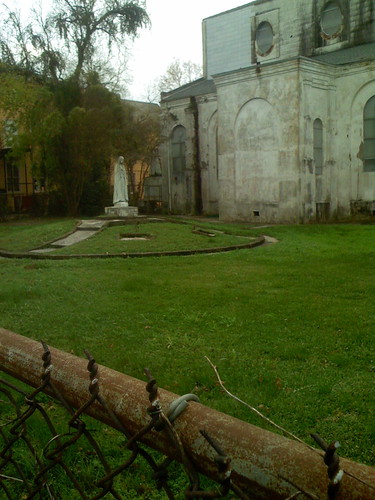
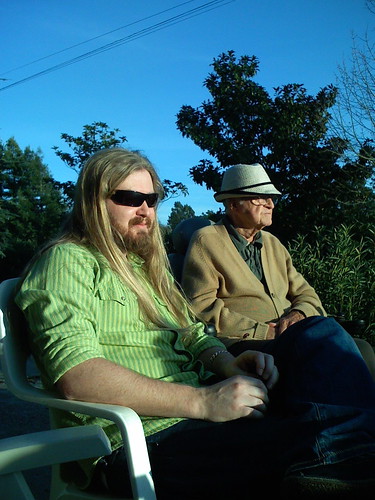
new photos

lots of new photos on flickr all taken with an iphone: www.flickr.com/photos/chr15-eat0n/

these tags should cover most of them

new orleans


friends
and family

lights/objects


1/30/08

transborder immigration project: empowering border crossers w/ gps


a very cool project, border disturbance is one of the best areas for combining activism and technology (via mobileactive.org)


November 17, 2007 |CorinneRamey


Ricardo Dominguez calls himself an "artivist." Half political activism and half art, Ricardo's projects blur the boundaries between the aesthetic and the political. "We always view our activism within the frame of art and the poetic," said Ricardo. Ricardo was part of a team that was recently awarded the Transnational Communities Award for a Transborder Immigrant Tool that uses GPS-enabled mobile phones to help immigrants crossing the border between Mexico and the United States.

MobileActive recently had a discussion with Ricardo on art, activism, and mobile phones. Ricardo, a researcher in the Calit2 lab at the University of California at San Diego, was given the award along with colleagues Brett Stalbaum, Micha Cárdenas and Jason Najarro. The project seeks to create a way for immigrants to orient themselves while crossing the border between the United States and Mexico, which is traversed by thousands of immigrants each year. The device seeks to reduce the number of deaths along the border by helping immigrants locate resources such as water caches and safety beacons.

The idea for the project arose from a program called the Virtual Hiker, a project of UCSD visual art professor Brett Stalbaum. "Brett gets lost even going to his house," joked Ricardo, "so he started working on a locative media project called the Virtual Hiker...He developed an algorithm that took into account a certain terrain, and created a virtual trial or hike based on those algorithms." By using GPS, the program created virtual hikes and would orient the user towards certain landmarks. Brett was able access "the kind of utility cloud that GPS offers," said Ricardo.

The Virtual Hiker program led the team to question ways that GPS technology could be used to help immigrants crossing the border. "We asked ourselves, what were the spaces of necessity or danger on the border, and how could we plug in this new element of the GPS structured cell phone?" said Ricardo. The answer to that question was the Transborder Immigrant Tool.

The tool is built on a Motorola i455 phone, which offers several advantages. Not only is the phone cheap -- about $40, according to Ricardo -- but no service is required for GPS functionality. "What we needed was a really inexpensive telephone, one that we could crack the GPS system, and one that would accept new algorithms."

The team took language into account when designing the application. "We needed to design the interface in a way that would be somewhat universal in terms of the community that would be crossing the border," he said. Many of the migrants are from indiginous communities, and wouldn't necessarily speak Spanish. The end result was a navigation system that looks like a compass. The phone also vibrates in response to certain landmarks, like water or a highway. The vibrations allow the user to concentrate on the surrounding environment instead of constantly looking at the screen of the phone.

Ricardo sees even the interface of the phone as having artistic value. "We were trying to think of many layers of communication -- iconic, sound, vibratory," he said. Additionally, the program helps the user not only avoid getting lost, but helps him or her find a more aesthetic route. "The algorithm would look at it not just in terms of a map or a politics but by suggesting the most aesthetic crossing," he said. Eventually, the people using the tool to cross the border would form an imaginary "mass desert painting" or "walking art," Ricardo said. "All the immigrants that would participate would in a sense participate in a large landscape of aesthetic vision."

The project is still in its preliminary stages, but by the end of next year the team hopes that it will be a working and usable tool. "In the next stage, the research team will go to both ends of the border and work with the tools directly in terms of triangulating the info to the satellites," said Ricardo. The final step of the project will include workshops and trainings with groups that work with immigrants who are getting ready to cross the border. Possible partners include Casa Imigrante and the Centro de Informacion para Trabajadoras y Trabajadores (CITTAC). "We hope to get them to communities that interface with people getting ready to cross," said Ricardo.

Ricardo says that the team currently has enough funding to pay for 500 phones, and hopes to purchase more in the future. He also mentioned the possibility of adding about $50 of phone time to each tool, although, he said, that team recommended only using the tools as phones in emergencies for security reasons. The team is also working with a group of teachers to design a simple pamphlet with instructions on how to use and upgrade the tool. He hopes the instructions will be similar to the safety cards available on airplanes -- they'll rely more on pictures and icons than language.

Ricardo sees the Transborder Immigrant Tool as part of a larger trend of border disturbance art. "There's a long history of artists at the border creating gestures that question the very nature of the border," said Ricardo. Because disturbance art is framed as art, and not as solely political activism, the "artivists" are given more leeway politically. "The reason they can't stop us is that we always frame all these gestures within the poetic frame." By framing politics as art, and art as inextricably linked to politics, projects like the Transborder Immigrant Tool are able to survive as both a life-saving device and an "artivist" concept.

Photo courtesy of Ricardo Dominguez.